
Your ABM Programme Is Running. Your Pipeline Is Not. Here Is Why.
A guide on how to fix your ABM Pipeline.
Last year, I was called into three B2B companies to audit their ABM strategy and operations.
All three had AI-powered tools. All three had dedicated teams. All three had dashboards full of green metrics.
None of them had a pipeline that was moving.
I am going to tell you what I found. Because the problem was the same in all three cases. And I suspect it might be the same in yours.
But first, one thing to understand. ABM is not a marketing strategy. It is a commercial strategy. Keep that in mind as you read what follows.
Company One: They Automated Before They Were Ready
Series B SaaS business. Selling into mid-market manufacturing. Good product, genuine customer love, strong retention.
They had been running AI-powered ABM sequences for six months. Pipeline impact was close to zero.
First thing I asked for: the CRM data.
What I found was roughly 40% data decay. Wrong job titles. Acquired companies with new ownership. Decision-makers who had left twelve months ago.
The AI was personalising outreach at scale to people who no longer existed in those roles. Personalised garbage. Delivered efficiently. At volume.
The platform was not broken. It was doing exactly what it was built to do. The data it was working from was the problem.
Nobody had checked the data before switching the automation on. Why not?
Because nobody owned that decision. Marketing owned the platform. Sales owned the CRM. RevOps did not exist.
Two teams, two sets of metrics, zero accountability for the commercial outcome.
That is not a technology failure. That is a leadership failure.
Company Two: The ICP was a fiction
FinTech company. Payments infrastructure. Enterprise sales.
Beautiful ICP document. Firmographics, technographics, buying committee persona cards for every stakeholder. Genuinely impressive work.
One problem. Nobody in sales had been involved in building it.
I sat down with the three most senior account executives and asked them to describe their best customers.
The picture they painted was completely different from the ICP document. Different industries. Different company sizes. Different trigger events. Different budget holders.
Marketing was targeting one profile. Sales was pursuing another. Both teams were working hard. Neither team was working on the same problem.
The AI personalisation was flawless. It was reaching exactly the wrong people with perfectly crafted messages.
I asked who owned the ICP definition.
Long pause. Marketing thought they did. Sales thought they should. The CEO assumed both teams had aligned on it months ago.
They had not. Nobody had made that call. And nobody had noticed, because each team was hitting their own internal metrics while the shared commercial outcome quietly collapsed. Sales was chasing pipeline volume. Marketing was chasing lead numbers. Nobody was chasing alignment. Nobody owned revenue.
Company Three: Sales Had Already Checked Out
B2B professional services firm. Targeting CFOs at mid-market businesses.
Marketing was running a sophisticated one-to-few ABM programme. Personalised content, targeted LinkedIn advertising, account-specific landing pages, and triggered sequences based on engagement scoring.
The engagement metrics were strong. Sales were ignoring the leads.
Not because they were lazy. Because they did not trust the scoring.
The last ABM-sourced leads they had followed up on were completely unqualified. A contact with no budget authority. A consultant researching on behalf of someone outside the target market. An existing customer clicking through out of curiosity.
Sales made a quiet decision. ABM leads were not worth the time.
They went back to their own outbound motion and stopped picking up what marketing was sending them. Marketing had no idea. The handoff was not tracked.
Leads arrived in the CRM. What happened next was invisible.
By the time I arrived, marketing was optimising a pipeline that sales had already written off. Two teams operating in parallel universes. Politely pretending to be aligned in weekly standups. Neither team dishonest. Neither team connected.
Three Companies. Three Problems. One Root Cause.
When I wrote up the findings, I expected three different diagnoses.
I got one.
In every case, nobody owned the commercial outcome end to end.
Marketing owned their metrics. Sales owned their pipeline. Leadership owned the revenue target. But the gap between those three things, the gap where ABM actually lives, belonged to nobody.
This is not an ABM problem. It is not an AI problem.
It is a structural problem. And it is endemic in B2B companies that have split the commercial function into marketing and sales rather than treating it as a single engine with a single owner.
The Part of the ABM Pyramid Nobody Talks About
You know the three tiers. One-to-one for your highest-value target accounts. One-to-few for clusters of similar companies. One-to-many for broader programmatic coverage.
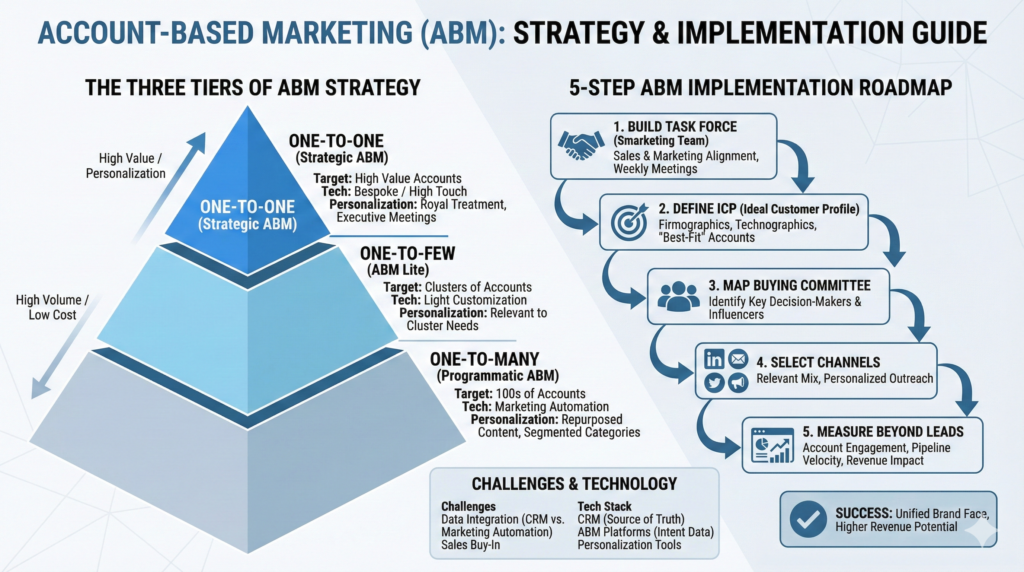
What the pyramid does not show is the vertical axis that makes all three tiers function.
Unified commercial leadership. Running through the centre of every tier. Connecting the intent signal at the top to the closed deal at the bottom.
Without it, the pyramid is a diagram. Not a revenue engine.
In all three companies, the pyramid existed on paper. The tiers were defined. The technology was in place. The campaigns were running.
But nobody owned the vertical axis. Each tier had a different owner, optimising for different metrics, reporting to different leaders.
That is not ABM. That is three separate marketing programmes wearing an ABM costume.
What Fixing It Actually Looks Like
In Company One, we stopped everything before we touched a single sequence.
Six weeks of data remediation. Systematic contact validation across the entire CRM. Target account list rebuilt from verified data only. We also appointed a single owner for data quality going forward, someone accountable for what went into the platform before the platform did anything with it.
Then, and only then, we switched the automation back on. Engagement rates jumped over 60% in the first month. Pipeline quality followed. The technology had not changed. The inputs had.
In Company Two, we ran a two-day ICP workshop. Marketing and sales in the same room. A neutral facilitator whose job was to call out the gaps when the two teams disagreed, and there were plenty.
We rebuilt the ideal customer profile from scratch. Grounded in the accounts that had actually closed and the deals that had collapsed at the final stage. Both sources mattered equally.
The revised ICP cut the target account list by nearly half. Pipeline conversion improved substantially within a quarter. Not because we worked harder. Because we stopped working on the wrong accounts.
In Company Three, the fix started with rebuilding trust between marketing and sales. That sounds soft. It was the most commercially urgent thing on the list.
We created a joint lead quality review cadence. Weekly. Both teams in the room. Every ABM-sourced lead reviewed against the agreed-upon criteria that both sides had co-designed together.
That last part matters. Co-designed. Not handed down from marketing. Not overridden by sales. Built together, so both teams owned the standard.
Within eight weeks, sales were picking up ABM leads again. Because they trusted what they were receiving. Because they had helped define what good looked like.
In none of these cases did we change the technology. We did not rebuild the strategy either.
We changed who owned the outcome. And we made that ownership visible, explicit, and non-negotiable.
The Question Worth Sitting With
If your ABM programme is generating activity but not revenue, do not touch the platform yet. Do not hire another agency. Do not rebuild the content.
Ask yourself one question first.
Who in your organisation is accountable for the commercial outcome end-to-end? Not the campaign metrics. Not the SQL target. Not the revenue number.
The entire chain from account selection to closed revenue, including everything in between.
If the answer is nobody, or it depends on who you ask, you have found your problem.
No AI-powered personalisation engine fixes a leadership gap. ABM is a commercial strategy. It needs a commercial owner.
Everything else is just an expensive activity.
I work with B2B companies as a fractional CCO and CMO, diagnosing commercial infrastructure and rebuilding revenue engines when pipeline performance does not match the effort being invested. If your ABM programme is generating activity but not revenue, reach out. No pitch. Just a straight conversation about what is likely broken and what fixing it would look like.